Cancer Biopsy Options
Why Cryopreservation is the New Standard
URL Slug: /cancer-biopsy-options-cryopreservation/
Meta Title: Cancer Biopsy Options: Why Live Tissue Preservation Matters
Meta Description: Explore cancer biopsy options like cryopreservation. Learn how preserving live tumor tissue unlocks precision medicine, clinical trials, and better testing.
Receiving news that you need a cancer biopsy is a heavy, life-altering moment. In the rush to get answers, most patients follow the “standard” hospital path without realizing they have a choice in how their tissue is handled. It is normal to feel overwhelmed and urgent, but this is the single most critical moment to pause and advocate for your future.
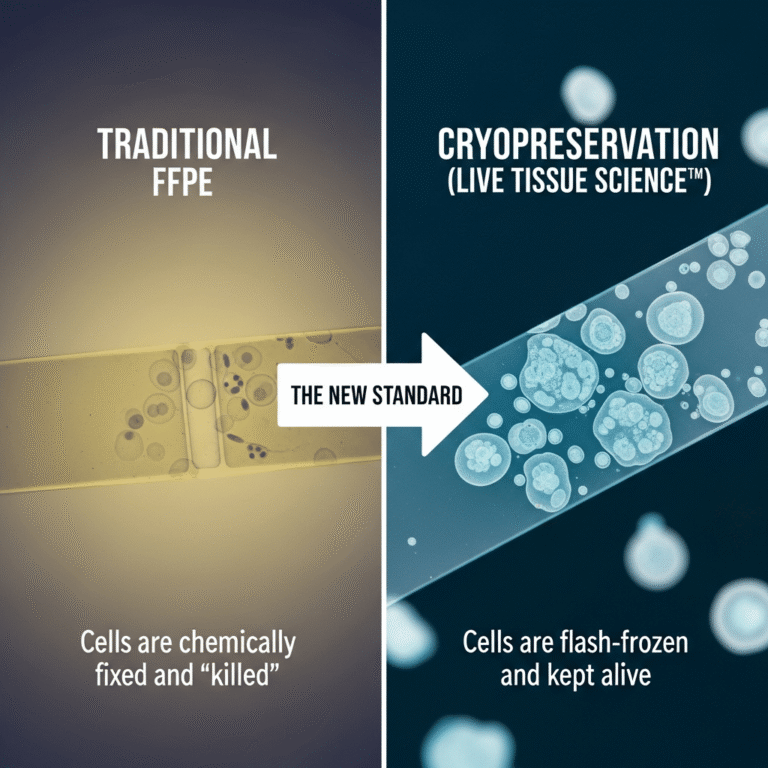
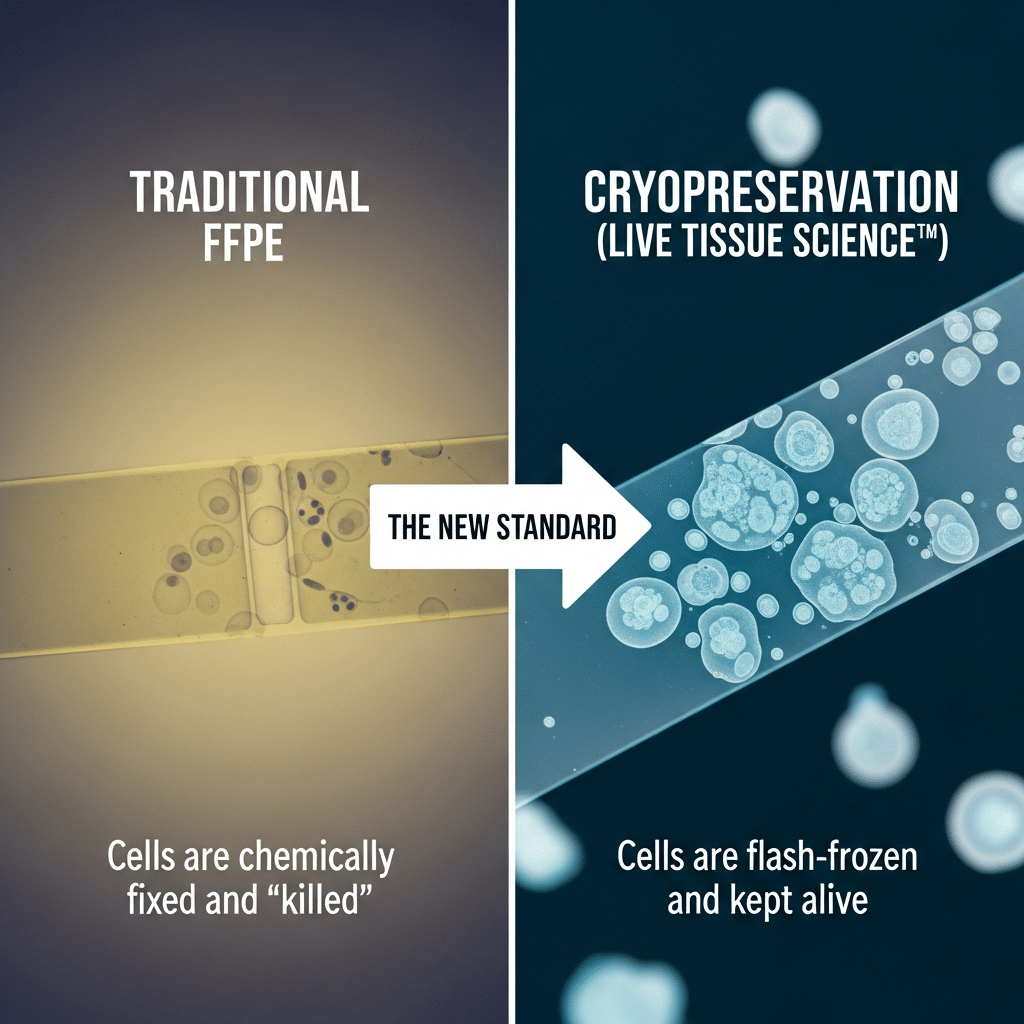
The way your tumor tissue is preserved at the moment of biopsy determines which treatments—and which clinical trials—will be available to you later. While hospitals typically use a 100-year-old method that effectively “kills” the cells for a quick look under a microscope, modern cancer biopsy options allow you to keep those cells alive. By choosing cryopreservation, you aren’t just getting a diagnosis; you are securing a “living library” of your cancer that can be used to test drugs, build vaccines, and power AI-driven diagnostics.
Quick Takeaways: What You Need to Know
-
The Default is Not Enough: Standard “FFPE” preservation degrades DNA/RNA and kills live cells.
-
Timing is Everything: Cryopreservation must be arranged before your biopsy or surgery occurs.
-
You Own the Tissue: Storing tissue with an independent biobank ensures you, not the hospital, control your medical assets.
-
Unlocks Testing: Live tissue allows for “ex vivo” testing—where drugs are tested on your cells in a lab, not on your body.
What are the Different Cancer Biopsy Options?
When your doctor performs a biopsy, they aren’t just taking a sample for a report; they are collecting the most valuable piece of data in your entire cancer journey. Historically, there was only one way to handle this tissue: FFPE (Formalin-Fixed Paraffin-Embedded). In this process, the tissue is soaked in formaldehyde and encased in wax.
While FFPE is excellent for looking at the shape of cells (morphology), it chemically “scrambles” the biological instructions. Today, a superior option exists: Cryopreservation. This involves flash-freezing the tissue in a way that keeps the cells viable.
Definition Box:
Cryopreservation is the process of preserving live tumor tissue at ultra-low temperatures (using liquid nitrogen). Unlike standard methods, it keeps the tissue’s biological “blueprint” intact, allowing it to be used for advanced testing and personalized therapies months or years later.
The Limitations of the “Standard” Hospital Method
Most hospitals operate on “system defaults.” Their primary goal is to reach a quick diagnosis. To do this, they use the FFPE method because it is cheap, stable at room temperature, and easy to store in a filing cabinet.
However, for a patient looking for every possible advantage, FFPE has significant drawbacks:
-
DNA Fragmentation: The chemicals used can break apart your DNA, making it harder for advanced genomic sequencing to get a clear read.
-
No Living Models: You cannot grow “mini-tumors” (organoids) from dead, waxed tissue.
-
Protein Masking: Many modern immunotherapies target specific proteins. Formalin can “mask” these proteins, leading to unreliable biomarker test results.
Why “Live Tissue Science™” Changes the Game
At SpeciCare, we utilize Live Tissue Science™. This approach views your tumor as a living entity that holds the key to its own destruction. When you choose to cryopreserve your tissue, you are keeping those cells “on pause.”
If your initial treatment doesn’t work, or if the cancer recurs, you don’t necessarily need another painful surgery. Your medical team can go back to your stored live tissue. They can use it for:
-
Functional Testing: Testing 300+ different drug combinations on your actual cells to see what kills the cancer.
-
Personalized Vaccines: Creating a vaccine specifically tailored to the unique mutations found in your tissue.
-
TIL Therapy: Extracting Tumor-Infiltrating Lymphocytes (immune cells) to be grown and re-infused into your body to fight the cancer.
Comparison: FFPE vs. Cryopreservation
| Feature | Standard FFPE (Hospital Default) | Cryopreservation (SpeciCare) |
| Cell State | Dead (Chemical Fixation) | Live (Suspended Animation) |
| DNA/RNA Quality | Degraded/Fragmented | Pristine/Intact |
| Future Testing | Limited to basic pathology | Unlimited (AI, Organoids, Vaccines) |
| Ownership | Usually held by the hospital | Owned and controlled by YOU |
| Best Use | Initial diagnosis | Precision medicine & long-term options |
The “Dirty Secret” of Tissue Ownership
Did you know that in most cases, once a hospital removes your tissue, they own it? If you want to seek a second opinion at a major research center or enroll in a cutting-edge clinical trial, you may have to fight through bureaucratic red tape just to get your own samples transferred.
By using SpeciCare to store your tissue, you take ownership of your biological assets from day one. Your tissue stays in a private, high-tech biobank, ready to be shipped anywhere in the world where the best treatment for you is located.
CTA: Talk to SpeciCare Before Your Biopsy
Don’t let the “default” hospital process limit your future. Before your biopsy or surgery, ensure you have a plan to preserve your tissue. Contact a SpeciCare Patient Advocate Today to order your collection kit.
Questions and Answers: What Patients Ask Most
1. Can I still do cryopreservation if I’ve already had my biopsy?
Usually, no. Cryopreservation requires the tissue to be “fresh” and frozen immediately after removal. However, if you are facing a second biopsy or surgery for a recurrence, that is the perfect time to start. If your tissue has already been processed in FFPE, we recommend blood cryopreservation as a backup for certain types of testing.
2. Does my doctor have to agree to this?
Most surgeons and oncologists are happy to support a patient’s wish to preserve tissue, but they may not be familiar with the logistics. SpeciCare handles the coordination between your medical team and the lab to make it a seamless process for your doctor.
3. Is this covered by insurance?
Standard pathology is covered, but the extra step of live tissue cryopreservation is often an out-of-pocket cost. Many patients view this as a form of “biological insurance”—an investment in future treatment options that may not even exist yet.
4. How much tissue is needed?
While even a small needle biopsy can often be preserved, we generally advise “the more, the better.” During a surgical resection, there is usually plenty of material to satisfy both the hospital’s diagnostic needs and your cryopreservation needs.
5. What is a “Biomarker”?
A biomarker is a biological signpost—like a specific protein or genetic mutation—that tells doctors how your cancer might behave. To learn more about how these guide your care, visit our Glossary.
6. How long can the tissue be stored?
Our process ensures that your tissue remains viable not just for months, but for years. It is kept in a state of suspended animation until you or your care team needs it for Testing Before Treatment.
What to Ask Your Doctor Before the Biopsy
Advocating for yourself starts with the right questions. Bring these to your next appointment:
-
“What is the standard preservation method this hospital uses for biopsy tissue?”
-
“Will there be enough tissue left over for me to seek independent cryopreservation?”
-
“Can we coordinate with SpeciCare to ensure a live sample is preserved?”
-
“If I need a clinical trial later, will the way we preserve this tissue today help or hurt my eligibility?”
-
“Are we testing for specific biomarkers during the initial pathology?”
-
“Who technically owns my tissue once it is removed from my body?”
The Caregiver’s Role: Being the Advocate
If you are supporting a loved one through this, you are the “research department.” While the patient focuses on healing, you can manage the logistics of tissue preservation. It is often the caregiver who makes the call to secure a SpeciKit and ensures it arrives at the hospital on time.
Summary: A Proactive Path Forward
-
Decide Early: You must choose your cancer biopsy options before the procedure begins.
-
Protect Quality: Cryopreservation preserves the “high-resolution” version of your cancer’s DNA.
-
Own Your Data: Keep control of your tissue so you can take it to any specialist or trial.
-
Enable Better Testing: Give yourself access to functional drug testing and personalized vaccines.
-
Discuss with Your Team: Talk to your oncology team about FFPE vs. Cryopreservation and how it fits your long-term plan.
Take the Next Step with SpeciCare
The “standard of care” is a baseline, not a ceiling. You deserve the highest quality data to fight your cancer. Whether you are newly diagnosed or preparing for surgery, SpeciCare is here to help you navigate your options with confidence and compassion.
Click here to speak with a Patient Advocate or order your Tissue Preservation Kit.
This article is for educational purposes only and is not medical advice. Talk with your oncology team about what’s right for your situation.